Crypto Challenges Writeup - p3rf3ctr00t CTF 2024
Introduction
I set out two cryptography challenges for p3rf3ctr00t ctf 2024. My challenges had one solve, which is hilarious. Goated had one solve, and I actually believe it was the harder challenge. Both were ranked easy, so, I guess I’m bad at setting easy challenges.
Prerequisites
I’m gonna assume you love cryptography, God knows for what reason. Also, it’s a technical article covering Python programming and requires some basic Maths understanding.
# Challenge 1 - Purr
Challenge Description
Read through the lines
Somebody is saying something
Are you listening?
Files
purr.py
from Crypto.Util.number import getPrime, isPrime, bytes_to_long
import random
import secret

p = bytes_to_long(secret.MESSAGE)
q = getPrime(len(bin(p)))
e = 0x10001
m = 0

random.seed(e)

while not isPrime(p):
        p += int(str(m)[:3])
        m += random.randint(e,e**8)

N = p*q
d = pow(e,-1,(p-1)*(q-1))
c = pow(m,e,N)

for i in (c,d,N):
        print(f"{i:o}")

"""
OUTPUT
13440044201120711746253541270641756166545564152162232253265273600654175754436332574742313757062751322324142115171003012204561465643073336224737264331457472223655306202313476270103165
13657206345673614157356155137415231007746055050423776177225661100113211637720425424400650017166132056424030510717203340376224015774561612225524162411125510052477216264641076413143301
16223347352133211674232375760347432535315067012373563711247576335070177543105232166305351557524335232075241014331105554670101335705704165713725061040774727612107105115342721443011525
"""
Flag
{4420adaf23b2dee057a27f16fb028470}
Solution
TLDR
This challenge involves asymmetric encryption (RSA), and since we’re provided with the values of c,d,e,N, we should be able to recover the values of m and p,q. The secret message was initialized as p, so we can reverse the logic that was done to it to make it a prime number, by subtracting every pseudo-random number generated till we get to the value m.
Normally, I would create a test environment with dummy data to work with such challenges, but with this one, it’s relatively easy to work from the bottom. I’ll start by recovering the value of m. It’s worth noting the last print statement is giving us output in octal format, which I did intentionally you had to suufffer. To reconvert from octal, prepend the prefix 0o to the numbers, and we can then recover m with the formula pow(c,d,N)

Next, we need to recover the primes p and q, and since we know the value of N,e,d, recovering the primes should be easy. I’ll use the module Crypto.PublicKey.RSA to do this (you can install pycryptodome to get access to this module).
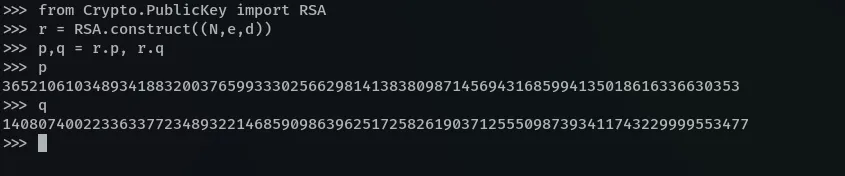
We needed to get the values of m and p,q, in order to reverse this logic below, which should then give us our secret message as the initial value of p. What’s happening here, is that the value of p is being incremented with the first three characters of m, and m is being incremented with a random number on each iteration. The iteration stops when p becomes a prime.
while not isPrime(p):
        p += int(str(m)[:3])
        m += random.randint(e,e**8)
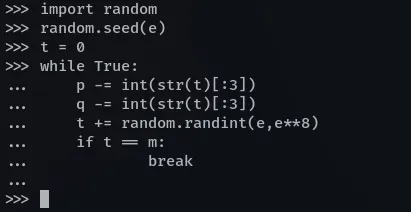
Since our random numbers were seeded insecurely, we can generate the same random numbers again using the same seed, which is e. To reverse this whole process, I’ll create a variable t that would start from zero, subtract it from p, continuously increment it with a random number using the same formula as used on m, and then to exit from the loop, I’ll compare if the value of t is equal to the value of m. (I’ll decrement both p and q in this logic since either of them could be the secret message).
The last step now is to decode the values of p and q to get our flag

Here’s the summarized script:
from Crypto.Util.number import long_to_bytes
from Crypto.PublicKey import RSA
import random

## load output, converting from octal base
c = 0o13440044201120711746253541270641756166545564152162232253265273600654175754436332574742313757062751322324142115171003012204561465643073336224737264331457472223655306202313476270103165
d = 0o13657206345673614157356155137415231007746055050423776177225661100113211637720425424400650017166132056424030510717203340376224015774561612225524162411125510052477216264641076413143301
N = 0o16223347352133211674232375760347432535315067012373563711247576335070177543105232166305351557524335232075241014331105554670101335705704165713725061040774727612107105115342721443011525

## known variables
e = 0x10001
random.seed(e)

## recover m
m = pow(c,d,N) # print(m)

## recover p,q
rsa = RSA.construct((N,e,d))
p,q = rsa.p,rsa.q # print(f"{p = }\n{q = }")

## extract either of p or q
t = 0
while True:
				q -= int(str(t)[:3])
        p -= int(str(t)[:3])
        t += random.randint(e,e**8)
        if (t == m):
                break

## decode message
for i in (p,q): print(long_to_bytes(i))
# Challenge 2 - Goated
Challenge Description
GOATS are born that way Their life trajectory is linear Balance their life equations and there’s no loophole
Files
goated.py
import random
import secret

SECRET = secret.MESSAGE

l = len(SECRET)
r = [random.randint(1,pow(2, 64)) for _ in range(l)]
rr = []

for i in range(l - 1):
    temp = sum([r[j]*ord(SECRET[j]) for j in range(l)])
    rr.append(temp)
    r = [r[-1]] + r[:-1]

print(f'{r}\n{rr}')

"""
OUTPUT
[11621753930912327951, 10742566629388821266, 17268623745609974948, 18105370276687096087, 8757011757287350447, 5895480531365402505, 245114310680920742, 10963193222072085487, 16250651213773773379, 10468878440672242075, 9776908174474231690, 10822618651411652260, 3140240693871318899, 5364348472772670922, 1599104714833413365, 14930799589123553164, 1942396699862249695, 8358583456696284854, 13037727751927896762, 4819885999441158740, 14494722953900378013, 2319353214571645883, 1048393966851434391, 12173882238361803005, 7150662287428708938, 14301919952020404121, 13853366396092578739, 6432524768977469408, 10197278592983087244, 8189439969692447451, 11325883053566038160, 1677067949722423530, 8689661737196756748, 4123692179195007034, 562441051419078930, 15162491279144741707, 10081030534077986029, 14884579975188846909, 15632043808834872341, 16650296531092369586, 12806846395630101389, 3329732078639477793, 15726321255673677840, 12342600439620429782, 15708566145292011892, 5720993242298782601, 3334549758167829646, 16580881521499039152, 12000841414943126512, 16781968094293608561, 1406913470571652142, 2239608497250055169, 3018313577480458690, 15973244404935958536, 9369775010123700156, 16355705281954587717, 7959034275369104941, 10188033857102208462, 14643382041411389383, 8220953598743502441, 12280226606764539052, 11905002423667883150, 3632747600677310094, 12330962420784189034, 7691214595522884755, 7947707641756019390, 4867572786847865828, 11785970258593918249]
[51585390923802250045799, 50211586224243189207094, 48784327320207480012259, 50987959456869983644472, 48209415904946249590358, 52317308250497227185146, 49132037652439883465353, 50435228215826442952650, 50060470223268680055150, 48895845666793997534661, 51263201239128178601161, 50301924324935318186402, 50984986290753767864379, 52209457146316424417976, 51330831070596192569536, 51266468253384796117462, 48862683153680575724487, 49939442807954384466539, 52692255356926023961048, 52720563621960551877686, 50924994687739740582996, 50951801031068409305688, 51049703499153487992250, 52100647302186803404218, 49723429978709891927129, 50560943868785889971154, 51717002082374553708917, 51875968257830322712431, 53667481267591682077648, 52819779985561727993135, 52146549948239383798369, 51865718633453882376253, 50290780759361376652274, 51757412922426369997973, 52256911134641441856007, 51454977225250593163703, 50422903221617080736597, 51114298802755659904111, 49651137859108278054208, 51390053546676447442405, 51068303235022216862598, 51828684437473220343958, 51884051061942744721829, 50137920450409680046466, 50626148165703249583898, 48873749970499856957485, 52520577827616135034914, 49886129012275107797364, 50801693609074196818089, 51598181179819332669994, 49562895854898452255611, 52986380894155821272696, 50786355283982966456012, 50741555943062531829276, 50815311823006485919674, 49340709429062082802229, 49571124158794255112214, 51021087101822569913213, 51715674842000060524511, 52066276177333405961958, 47978181290946395037346, 48768678047306255674704, 48226811120034075658446, 50921859179351096685386, 49770156910408517477077, 50370983321612745132160, 51334813200116244421169]
Flag
{5171b48652e3562912c6c89dd9494424}
Solution
TLDR
To solve this challenge, you needed to solve a system of linear equations, and that’s just it. Since we’re dealing with large numbers, the libraries you would need here are sagemath or sympy.
Here’s the script utilizing sympy
from sympy import *
from sympy.solvers.solveset import linsolve
import string

r = [11621753930912327951, 10742566629388821266, 17268623745609974948, 18105370276687096087, 8757011757287350447, 5895480531365402505, 245114310680920742, 10963193222072085487, 16250651213773773379, 10468878440672242075, 9776908174474231690, 10822618651411652260, 3140240693871318899, 5364348472772670922, 1599104714833413365, 14930799589123553164, 1942396699862249695, 8358583456696284854, 13037727751927896762, 4819885999441158740, 14494722953900378013, 2319353214571645883, 1048393966851434391, 12173882238361803005, 7150662287428708938, 14301919952020404121, 13853366396092578739, 6432524768977469408, 10197278592983087244, 8189439969692447451, 11325883053566038160, 1677067949722423530, 8689661737196756748, 4123692179195007034, 562441051419078930, 15162491279144741707, 10081030534077986029, 14884579975188846909, 15632043808834872341, 16650296531092369586, 12806846395630101389, 3329732078639477793, 15726321255673677840, 12342600439620429782, 15708566145292011892, 5720993242298782601, 3334549758167829646, 16580881521499039152, 12000841414943126512, 16781968094293608561, 1406913470571652142, 2239608497250055169, 3018313577480458690, 15973244404935958536, 9369775010123700156, 16355705281954587717, 7959034275369104941, 10188033857102208462, 14643382041411389383, 8220953598743502441, 12280226606764539052, 11905002423667883150, 3632747600677310094, 12330962420784189034, 7691214595522884755, 7947707641756019390, 4867572786847865828, 11785970258593918249]
rr = [51585390923802250045799, 50211586224243189207094, 48784327320207480012259, 50987959456869983644472, 48209415904946249590358, 52317308250497227185146, 49132037652439883465353, 50435228215826442952650, 50060470223268680055150, 48895845666793997534661, 51263201239128178601161, 50301924324935318186402, 50984986290753767864379, 52209457146316424417976, 51330831070596192569536, 51266468253384796117462, 48862683153680575724487, 49939442807954384466539, 52692255356926023961048, 52720563621960551877686, 50924994687739740582996, 50951801031068409305688, 51049703499153487992250, 52100647302186803404218, 49723429978709891927129, 50560943868785889971154, 51717002082374553708917, 51875968257830322712431, 53667481267591682077648, 52819779985561727993135, 52146549948239383798369, 51865718633453882376253, 50290780759361376652274, 51757412922426369997973, 52256911134641441856007, 51454977225250593163703, 50422903221617080736597, 51114298802755659904111, 49651137859108278054208, 51390053546676447442405, 51068303235022216862598, 51828684437473220343958, 51884051061942744721829, 50137920450409680046466, 50626148165703249583898, 48873749970499856957485, 52520577827616135034914, 49886129012275107797364, 50801693609074196818089, 51598181179819332669994, 49562895854898452255611, 52986380894155821272696, 50786355283982966456012, 50741555943062531829276, 50815311823006485919674, 49340709429062082802229, 49571124158794255112214, 51021087101822569913213, 51715674842000060524511, 52066276177333405961958, 47978181290946395037346, 48768678047306255674704, 48226811120034075658446, 50921859179351096685386, 49770156910408517477077, 50370983321612745132160, 51334813200116244421169]

r = [r[-1]] + r[:-1]

for t in string.ascii_letters:
        x = r
        b = []
        for i in range(len(rr)):
            b.append(rr[i] - ord(t) * x[-i])
        #print(b); exit()
        a = []
        for i in range(len(rr)):
            a.append(x[1:])
            x = [x[-1]] + x[:-1]
        #print(a); exit()

        g = linsolve((Matrix(a), Matrix(b))).args[0]
        print(f'{t} ', end='', flush=True)
        try:
            print('\n\nFOUND\n\n' + ''.join([t] + [chr(j) for j in g]))
            break
        except:
            None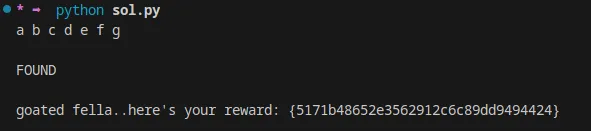
Conclusion
I realized they should have been rated maybe medium. But I hope they make sense now. On an unrelated note, in case you were wondering about the flag hashes: